Morpheus
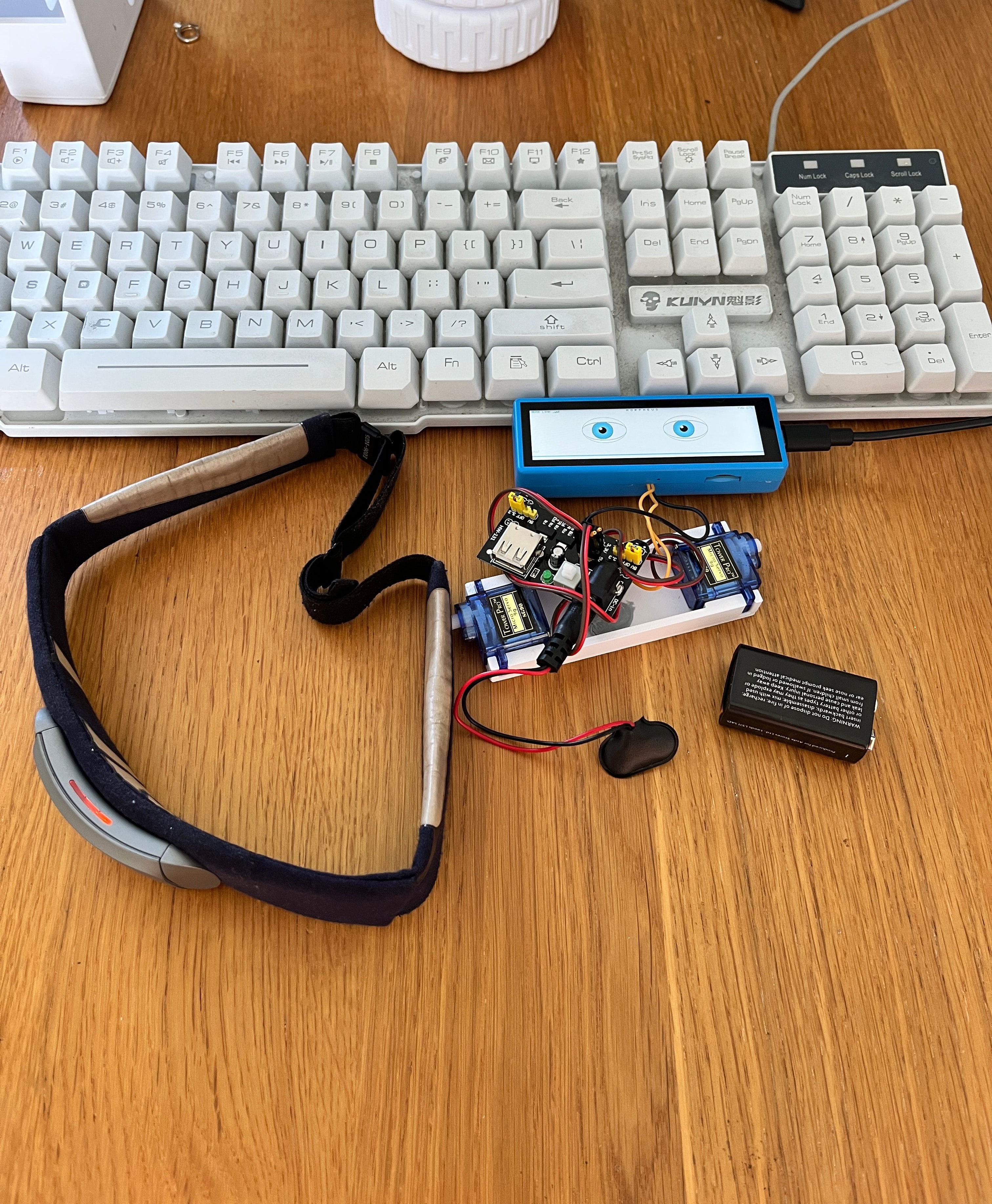
A two-wheeled desk robot with a face, driven entirely by expression. A headband reads the wearer's brain and head motion; the robot reads the headband. There is no phone, no remote and no button.
Everything. Firmware, electronics and interaction design, alone.
Self-directed
Working prototype
ESP32-S3, Muse S EEG, Bluetooth Low Energy, C++, PlatformIO
The idea
Most wearable sensing ends at a chart. Morpheus V1 asks what happens if the signal goes somewhere instead — if a body's own electrical activity moves an object in the room, immediately, while you are still making the expression that caused it.
The robot has a wide bar display carrying a pair of eyes and a live waveform that serves as its voice. It looks back at you. That is the point: the loop closes visibly, and nothing pretends to be more than a machine responding to a signal.
The controls
Every input is a face or a head. The gesture set was kept to four, because a control scheme you have to remember is a control scheme that fails in front of an audience.
| Furrow your brow | Accelerate. Hold to cruise. | |
| Blink twice | Brake, then reverse. | |
| Tilt your head | Steer, left or right. | |
| Blink once | It blinks back. |
How it works
A Muse S headband streams four channels of brain activity and six axes of motion over Bluetooth Low Energy to a single ESP32-S3 board. A gesture engine runs a fifty-times-a-second control loop across that stream. An onboard microphone feeds the waveform voice, and two continuous-rotation servos in a differential drive do the moving.
The part that took the longest
The headband's Bluetooth protocol is not published. Real-time gesture decoding meant taking the connection apart — watching the traffic, mapping the structure, and writing a client from scratch that could parse the sensor stream fast enough to hold a fifty-hertz loop. Roughly no part of that was in a datasheet.
Hardware
One board runs the whole robot: a dual-core Xtensa LX7 at 240MHz with 8MB of memory and 16MB of storage.
| Display | 172 × 640 IPS, QSPI | |
| Microphone | Dual MEMS, I²S at 16kHz | |
| Motion sensing | Six-axis IMU | |
| Drive | Two continuous-rotation servos, differential | |
| Control link | Muse S, Bluetooth 5, four-channel EEG and six-axis motion |
The manual
The robot has its own manual — systems architecture, hardware schedule and gesture reference — written and set to the same standard as the object it describes. A prototype nobody can operate without you in the room is only half a prototype.