Loading…
02
Focal - NHS Hackathon
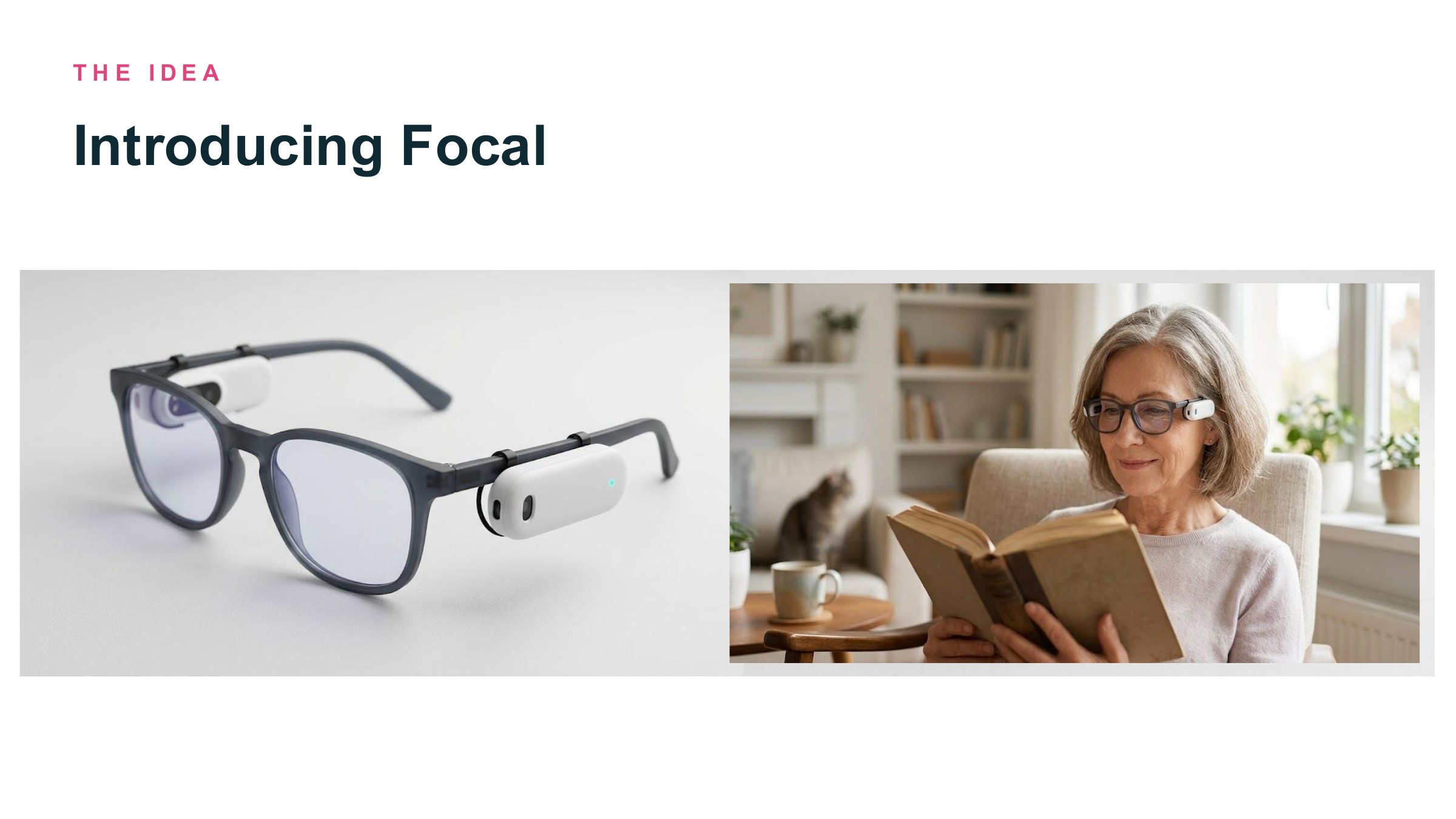
A clip-on wearable for ordinary glasses that records how a patient actually uses their vision — near, intermediate or distance — so the lens chosen for them fits their life rather than their memory of it. Built by me and my team at Hack4Health, Moorfields Eye Hospital.
September 2026
Working prototype
Python, Computer vision, VS Code
The problem
Before cataract surgery, the surgeon chooses a permanent lens target — near, intermediate or distance — from a questionnaire and the patient's own recall. Optometrists recommend and refer with no objective record of how each patient uses their eyes day to day. And afterwards there is little structured feedback on whether the lens chosen matched the life it was chosen for.
13 million
NHS sight tests in England
~600,000
Cataract operations in England
The brief
How can we provide an objective measure of visual behaviour? Objective, meaning measured from the eye itself rather than from what a patient remembers. Inclusive, meaning it works for patients with cognitive impairment or who are non-verbal.
How it works
The first version used a laser rangefinder to measure how far away the object in the wearer's line of sight is. The second looks at the eye instead: an infrared sensor tracks pupil diameter, which constricts when focusing up close and dilates when looking into the distance. Because the pupil also responds to light, an ambient light sensor supplies the context to correct each reading.
The clip at the foot of this page is the pupil-tracking algorithm at work, measuring diameter frame by frame against a baseline.
What the clinician sees
A share of viewing time by distance — near, intermediate and distance — together with the dominant eye. Not a verdict, but a clear, real-world starting point for the conversation about lens options, and help in planning which eye gets which lens.
What it costs
Estimated from 2026 supplier prices, excluding VAT and margin.
| Infrared sensors | £9.50 | Two pupil cameras, IR lights and lens film |
| Distance and light | £3.80 | Laser rangefinder and ambient light sensor |
| Casing | £3 | Left and right clip shells |
| Electronics | £18 | Processor, battery, boards, build and test |
| Per pair at 1,000 units | ~£35 | £68 for a first run of 100 |
Plus around £15–30k one-off for injection moulds and safety testing.
Where it goes
Now: cataract lens choice, with the device clipped on at pre-assessment. Next: spectacle lens choice, for clinical pathways — non-verbal, cognitive, myopia — and bespoke dispensing. Later: attention, tracking where and how long people focus, built into other wearables.
The business model is low-cost devices with a long-term dashboard subscription.