Loading…
01
Sleep Free OSA - at home sleep apnoea diagnostic wearable
Sole designer. Clinical research, electronics, testing, design for manufacture, costing.
2025–26
Built and tested
Fusion 360, ESP32-S3, C++, Signal processing, 3D printing, Cut-and-sew

The problem
Around 936 million adults live with obstructive sleep apnoea. Roughly four in five of them do not know it. The test that would tell them means a referral, a waiting list and a night spent sleeping in a room that is not theirs, wired to a machine — which is a strange way to measure how somebody sleeps.
The standard treatment, CPAP, is abandoned by a large share of the people prescribed it. The mask, the hose and the noise put people off before the therapy has a chance to work. So the design brief was not only to detect apnoea, but to build something a person would still be wearing on the second night.
The object
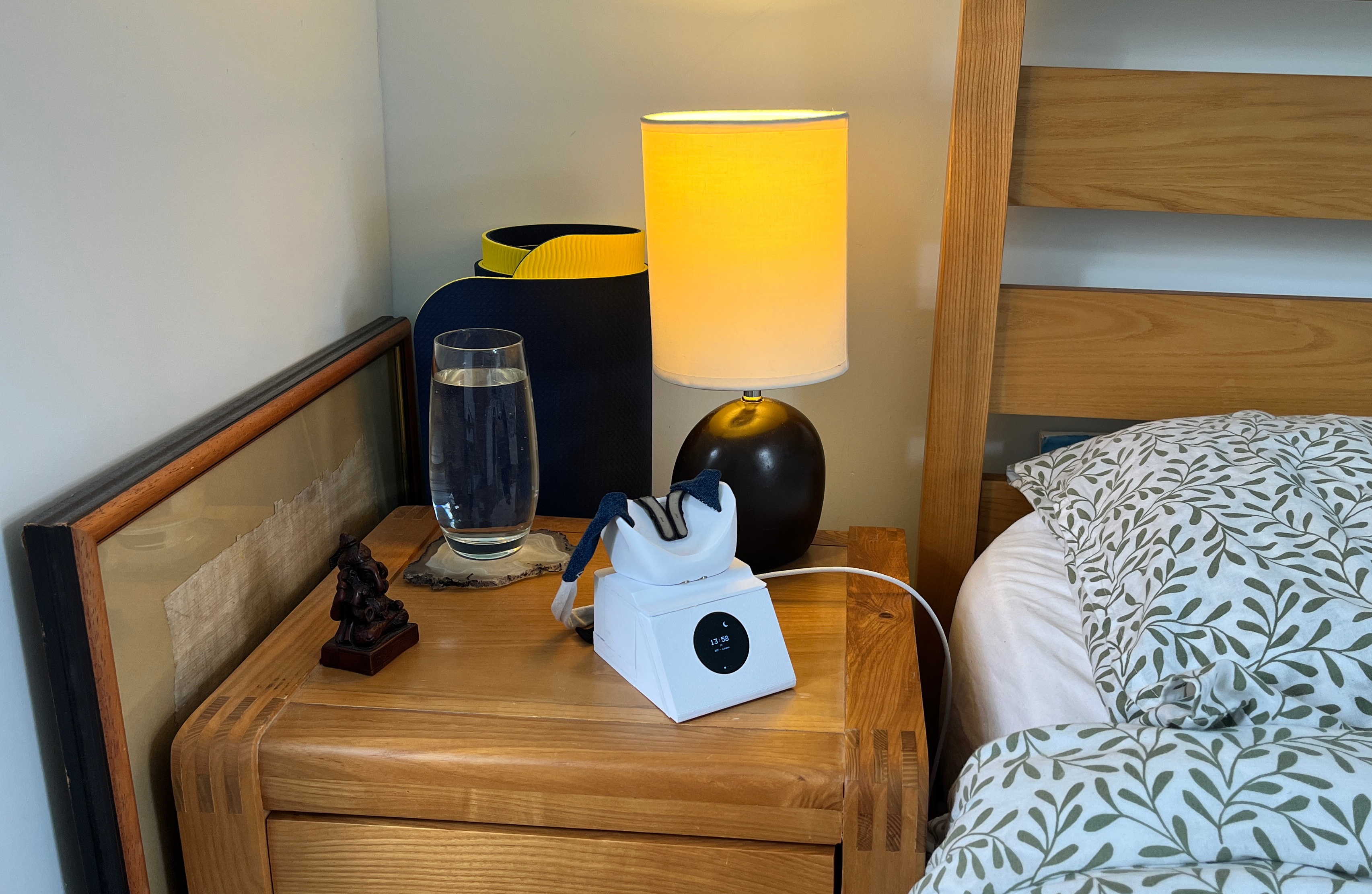
A soft chin-anchored cap connects to a bedside dock. It belongs to the same product class as Zeus Sleep and Signifier's eXciteOSA, and was taken from clinical research through self-built electronics and bench testing to a design-for-manufacture proposal.
How it works
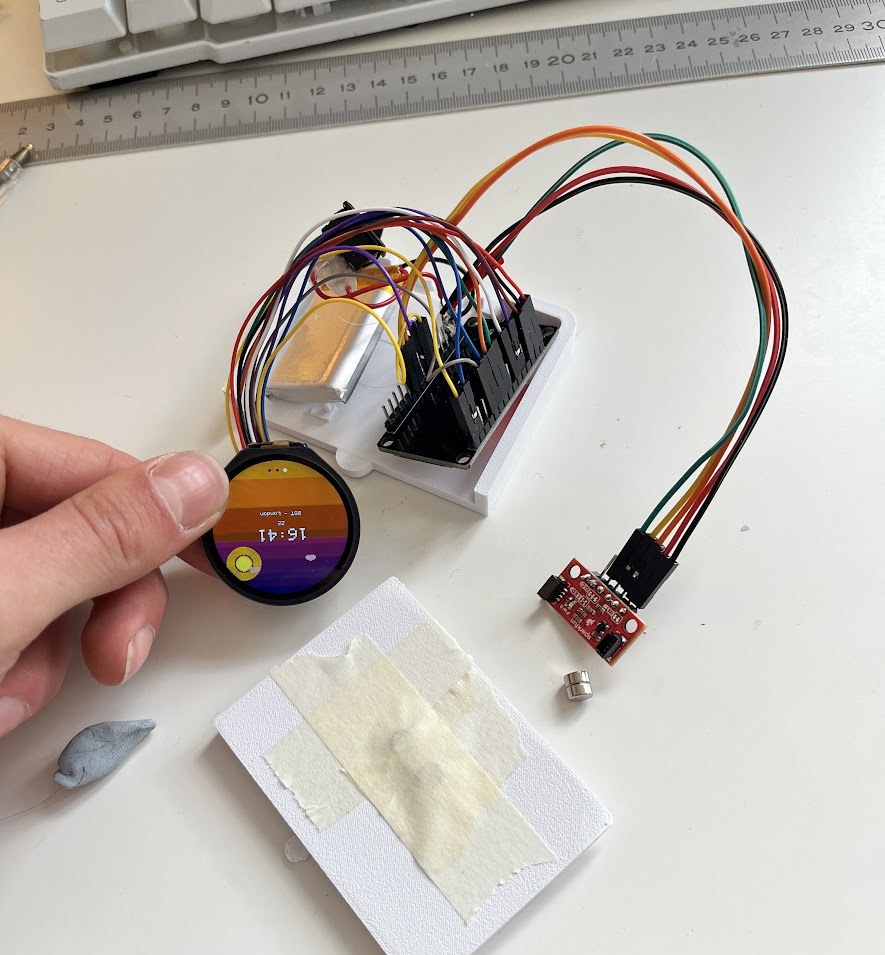
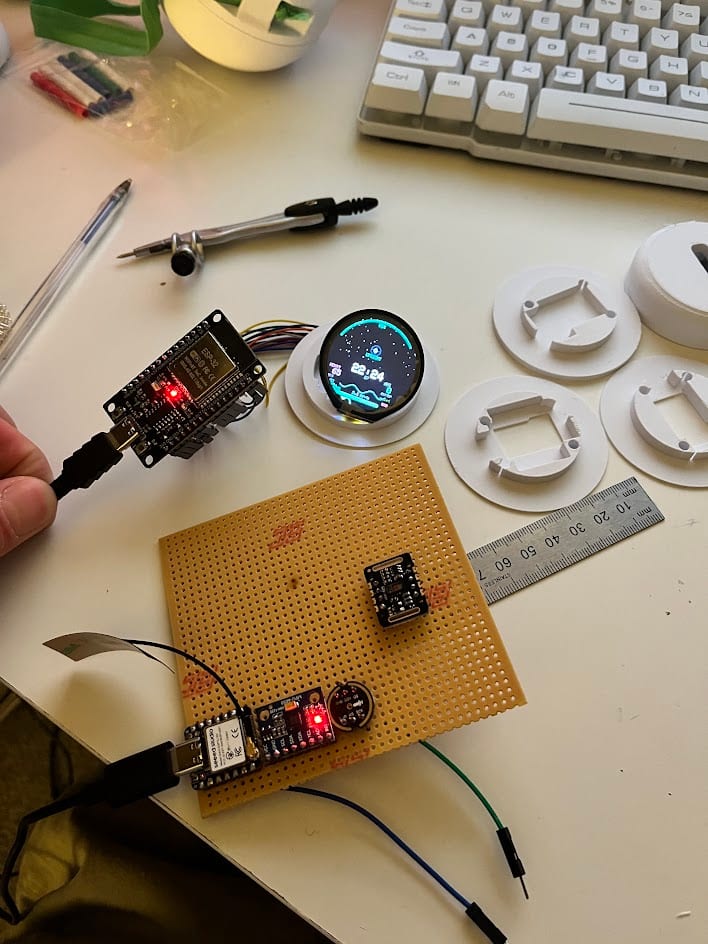
Conductive-fabric electrodes under the chin sense whether the device is being worn, and that reading wakes the system out of sleep mode. The wake then powers everything else: a microphone listening to the breath, an optical sensor for heart rate and blood-oxygen desaturation, and a motion sensor for sleeping position.
The evidence
The question was how to measure airway patency. The first answer was electrical: silver-conductive fabric electrodes under the chin, reading tongue and neck muscle. Across five configurations they beat the clinical silver/silver-chloride standard — and still could not say how open the airway was. The microphone could. Acoustic sensing became the diagnostic; the electrodes now sense wear.
14.76 dB
Silver-conductive fabric, signal-to-noise
9.85 dB
Clinical Ag/AgCl electrode, signal-to-noise
What testing changed
Comfort findings, reported as they came. Neon-green elastic straps performed best overall, because they adapted most consistently across different head shapes — though the routing across the front of the chin is still not right. A soft chin pillow beat hard plastic outright. Several early strap designs came off entirely during a night's sleep. Any electronics at the chin must stay inside the submental triangle to avoid the nerve layout in the neck.
Making it
Two devices: injection-moulded rigid housings, a cut-and-sew textile strap with sonically welded edges, and a custom PCB in each, laid out for the sensor set and sent for contract assembly. Cost is modelled across three annual volumes on a direct, indirect and tooling-amortised basis.
| Unit cost at 10,000 a year | £63.00 | |
| Unit cost at 100,000 a year | £31.77 | The commercial design point |
| Unit cost at 1,000,000 a year | £17.35 | |
| Target retail | £99–149 | The clinical incumbent is £495 plus £40 a month |
System cost of goods across three volume tiers.
Where it sits
Version one is a consumer wellness product — snore monitoring and sleep-quality feedback — not a regulated medical device. A later therapeutic version is planned as a regulated route.
Of the 936 million adults with the condition, the plausibly reachable and already-aware market is around 50 million. A target of 100,000 units a year is about 0.2 per cent of that.